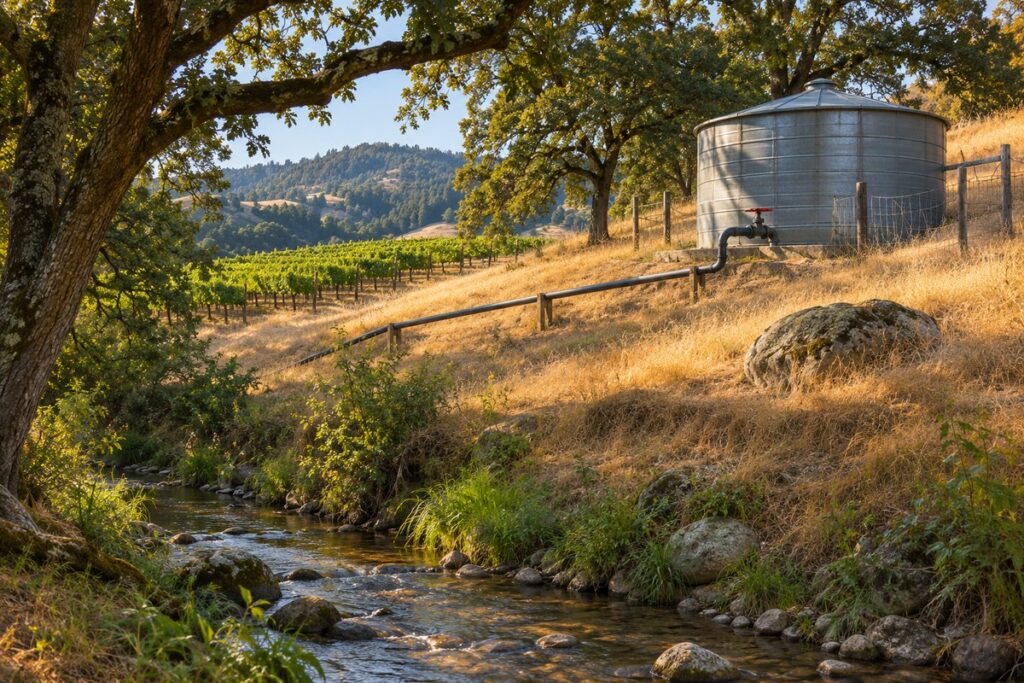
Put a water meter beside a row of cannabis plants and it will tell you when the crop was watered. Put it on the pipe that fills the farm’s storage tank and it may tell a very different story. A gallon can pass the second meter in February and the first in August. For a creek in northern California, the months between those two readings can matter as much as the gallon itself.
That distinction is easy to lose in an annual total. Plants need water during the dry growing season, just when many streams in the region carry relatively little. A farm that draws directly on a creek in summer and a farm that saved winter water can irrigate identical plots while placing their demand on the watershed at different times.
Three entries for the same water
Hydrologists can give the gallon three entries in a ledger: withdrawal from its source, time spent in storage and application to a crop. The last entry describes the crop’s water use in the ordinary farming sense. The first is closer to the event that matters to a fish downstream. Adding both meter readings would count a single gallon twice.
A study of storage and irrigation on North Coast farms used information reported by cultivators enrolled in a regional water program. Farms that placed water into storage between November and March needed to extract less during the April–October growing season. Storage often fell short of eliminating growing-season surface withdrawals. The likelihood that capacity would be sufficient depended on the storage infrastructure, the water source and the size of the planted area.
Switching to a well complicates the calendar further. As the US Geological Survey explains, groundwater pumping can reduce streamflow, and the response can lag behind pumping.
The records tell us about practices on participating farms. They are a much closer approach to the question than multiplying a plant count by an assumed daily water requirement. They still represent farmers’ reports, and a modeled withdrawal assembled from those reports has a different status from a flow meter installed in a stream.
A small demand in a small tributary
Imagine taking one bucket per minute from a large winter creek and then taking it from the same channel as it dwindles in late summer. The absolute withdrawal would be unchanged. The fraction of flow removed could be very different. For a stream animal, a little less water during a low-flow period may affect the depth of a pool or its connection to the next one. Locating an intake on a particular tributary matters for the same reason that locating it on a calendar does.
An earlier study of four northwestern California watersheds estimated potential demand from cannabis cultivation and compared it with streamflow. Its estimates drew attention to places where the two could come into conflict during low flow. Reading the word “potential” carefully leaves room to ask a better question. How much water actually came from that particular stream, and how much had already been put aside or obtained elsewhere?
Where the other water users fit
A subsequent watershed analysis compared cannabis demand with homes and other kinds of agriculture. Across the study region, cannabis accounted for a fraction of the demand from those other users. The researchers nevertheless found finer-scale periods and locations where it could add to stream depletion, especially where other demands were already present. Annual analyses obscured effects that appeared at shorter intervals.
Consider a map colored by the largest water user in each watershed. A small cannabis-growing area might barely register. Overlay a map of late-summer flows and draw the boundary of a single headwater catchment: the same farms could merit a closer look. Neither map would tell a complete story on its own, and a result from one creek in a drought year need not describe the basin next spring.
The irrigation meter by the plants has answered its question perfectly well. To understand what happened in the creek, you also need the entry from the storage tank, the source that supplied it and the streamflow on the day that water was taken. In this kind of accounting, the date belongs next to the volume.