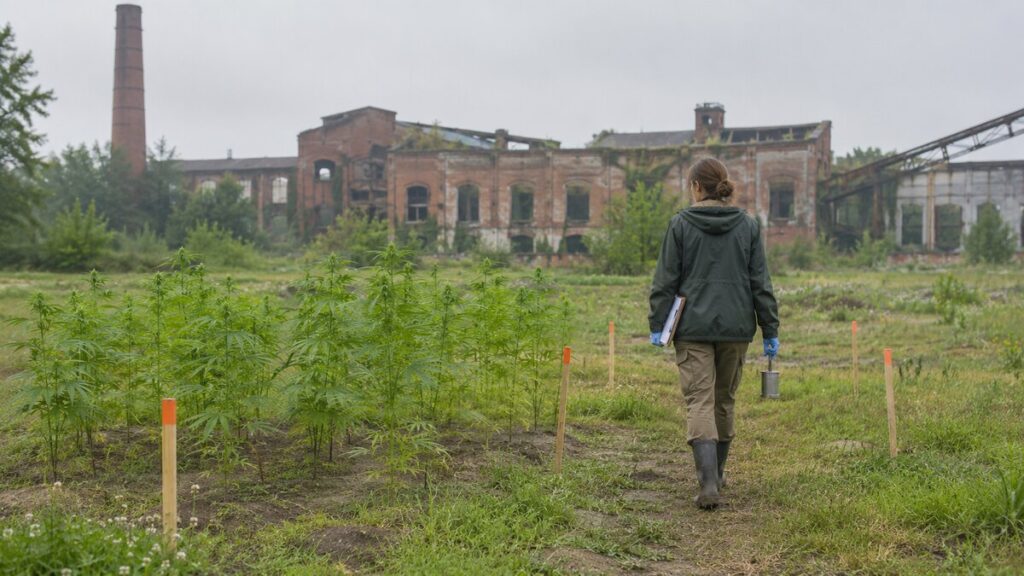
The hemp in the experimental pot is unmistakably taking up metal. A leaf sample proves it. Across town, the owner of a former industrial site has a less easily answered question. How many years would a crop need to reduce contamination across the whole property? The pot has supplied evidence for one step in the proposed cleanup. The years depend on a balance sheet that extends well beyond the pot.
A hectare contains an extraordinary amount of soil
Take a purely illustrative field measuring one hectare, or ten thousand square meters. Its upper twenty centimeters contain two thousand cubic meters of soil. At an assumed dry bulk density of 1.3 metric tons per cubic meter, that layer weighs about 2.6 million kilograms. Lowering the average concentration of a metal in that layer by just one milligram per kilogram would require removing about 2.6 kilograms of the element, if everything else stayed constant.
That arithmetic is intentionally simple. It tells us why a leaf with an impressive concentration can coexist with a disappointing cleanup rate. A real calculation would need measurements of soil depth, density and the distribution of contamination. It would also need an agreed target. A deep patch beneath an old discharge point can matter much more to a site’s future use than a broad average suggests.
Multiply by the crop that actually grew
To estimate seasonal export, investigators multiply the measured concentration in harvested material by the amount harvested. A plant that accumulates a high concentration but grows poorly may remove less total metal than a vigorous crop with a more modest concentration. A controlled hemp study illustrates why investigators examine growth as well as tissue chemistry. A concentration ratio alone contains no information about how many kilograms of plant material are available to take away.
Field measurements are especially valuable here. Researchers working in Slovenia’s Celje Valley examined hemp on actual agricultural sites with different levels of contamination. Site-to-site differences are scientifically inconvenient when someone wants a single removal rate. For a landowner they are precisely the point. Weather, soil conditions and the crop’s response determine whether an encouraging result can recur outside a controlled experiment.
The part a root can reach changes with time
A chemical measurement of total metal in soil does not say how much can enter the soil solution during the growing season. Some may be bound to minerals or organic matter. The soil conditions in a recently prepared test mixture may differ markedly from those on land where residues have weathered for decades. A review of hemp for contaminated soils considers such questions of field applicability alongside the promise of the crop.
An assessment of metal extraction from contaminated soils explains how the projected timetable changes when the goal concerns the soluble fraction rather than all the metal in the soil. Even a reliable first-year removal figure cannot simply be multiplied by twenty. Suppose the first crop draws mainly from the most accessible fraction. Later crops may face a smaller supply even while much of the total metal remains underground. The opposite complication is a continuing input from runoff or dust. Measuring what leaves is essential, but a field with metal still arriving has another entry in its balance sheet.
What would count as a successful cleanup?
The EPA’s introduction to phytoremediation describes the importance of root depth, site conditions and the time available for treatment. Where the main concern is movement of contaminated dust, stable vegetation may help through a pathway quite different from extraction. Where the objective is a measured decline in the soil inventory, that decline needs to be demonstrated at the relevant depth and scale.
The strongest follow-up to a successful pot study would therefore include repeated field measurements, a realistic harvest record and a documented destination for the material removed. At that point the landowner can ask a more useful question than whether hemp absorbs metals. Is the annual amount leaving this property large enough to bring a specified part of the soil to its target within the time available?