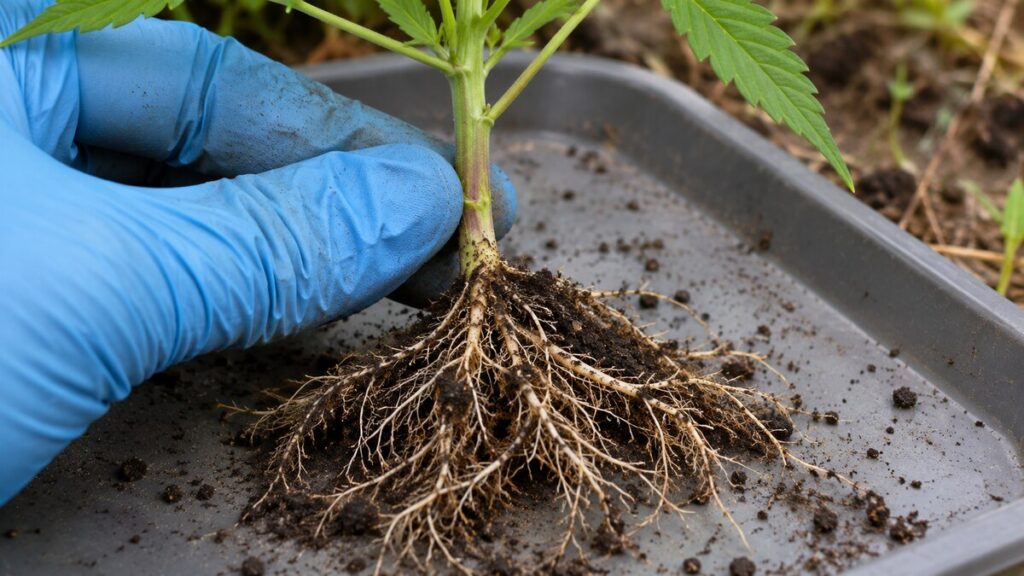
Picture a harvested hemp field at the end of summer. The stems have left on a truck. Most roots remain underground, and a layer of fallen leaves lies between the rows. If the crop took up cadmium while it grew, how much of that cadmium has actually left the field? A laboratory result showing metal inside a plant is a start. The next questions concern which part was sampled and which parts made it onto the truck.
One plant, several chemical addresses
A root encounters metal in the soil solution. Some can remain associated with its surface or be retained in root tissues. Some may enter the plant’s transport system and reach stems, leaves or reproductive structures. The proportions depend on the element, the soil conditions, the plant and its stage of growth. Measuring one leaf does not provide a reliable map of all the tissues attached to it.
A review of heavy metals in industrial hemp illustrates the problem with a universal rule. Studies of chromium often found appreciable retention in roots. A controlled study comparing hemp leaves and stems, meanwhile, found higher cadmium and lead concentrations in leaves than stems under the treatment it examined. These are answers about particular elements and growing conditions. They need not hold for another crop on a different patch of ground.
Which part holds the largest amount?
Concentration is the amount of an element per unit mass of tissue. To learn how much metal a plant part contains altogether, the analyst also needs the mass of that part. Imagine a harvest with one kilogram of dry leaves containing ten milligrams of a metal per kilogram. Those leaves hold ten milligrams. Ten kilograms of stems containing only two milligrams per kilogram hold twenty. In this example the leaves have the higher concentration while the stems carry off twice as much metal.
In one field trial, investigators analyzed seeds, leaves, fibers and the woody core separately. Combining the last two fractions as “stem” would have obscured a distinction that matters when hemp is processed.
Real plants add another complication. A kilogram of fresh stem and a kilogram of dry stem contain different amounts of water. A trustworthy comparison makes the mass basis explicit. Otherwise a wet tissue can look deceptively dilute beside a dry one. The same care applies to surface dust on leaves and soil adhering to roots. What the laboratory includes in the sample helps determine what its result means.
Following the material beyond harvest
A field investigation in Slovenia’s Celje Valley examined two industrial hemp varieties at three locations with different contamination histories. The researchers measured metals in different plant parts as well as the soils. This kind of field study helps answer a practical question about disposal or use. What material would someone actually be handling after harvest at this particular site?
If most of an element remains in roots, taking away stems will remove relatively little of it. Fallen leaves can also return material to the soil. If a substantial amount does leave in the harvest, its destination matters. Turning a contaminated stem into another product moves the element into another setting. A process that reduces a large quantity of plant material to a small quantity of residue can leave a more concentrated material to manage.
The last entry in the ledger
The US Environmental Protection Agency’s primer on phytoremediation treats the fate of harvested biomass as part of the cleanup question. It also distinguishes extracting contaminants from stabilizing them in place. Plant cover can sometimes serve a useful purpose by limiting movement of contaminated material even where the mass exported in a harvest is modest. The evidence appropriate to one goal differs from that needed for the other.
For the truck leaving the field, the calculation is tangible. Record which tissues it carries, their dry mass and their measured metal concentrations. Then account for what stayed behind. Only after those entries are made can the analyst say how much metal crossed the field gate and how much remains someone’s responsibility inside it.