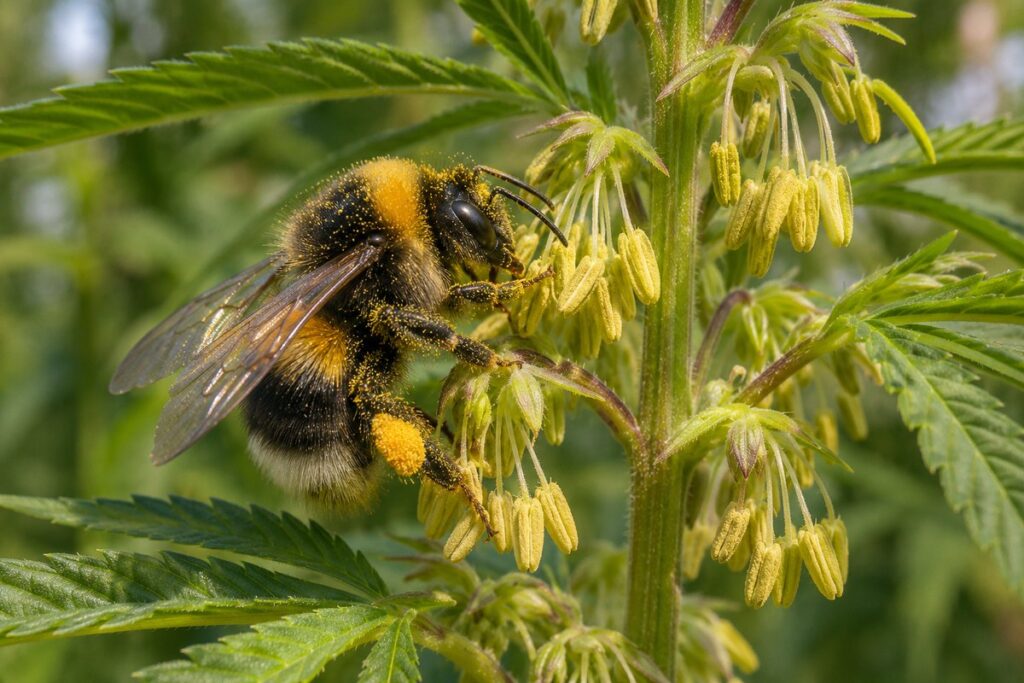
A honeybee has little difficulty finding a sunflower. The puzzling sight is a bee busily working a hemp flower. Hemp sheds pollen into the air, and the flower offers no nectar. Yet when entomologists visited flowering fields in Colorado and New York, they found honeybees, wild bees and a much richer assortment of visitors than the crop’s modest blossoms might suggest.
Late summer gives those visits a context. On some agricultural landscapes, the stretch between one crop finishing and another blooming leaves comparatively little pollen within reach. A field of male hemp flowers can shed a great deal of it during that interval. Whether bees take advantage of the opportunity, and whether the opportunity measurably improves their fortunes, are separate field questions.
The food a hemp flower can offer
Nectar and pollen supply different parts of a bee’s diet. Nectar provides sugar for energy. Pollen provides protein and other nutrients, including food used to rear young. A pollen-rich flower can therefore attract a forager even when she has to get her fuel elsewhere. The US Geological Survey describes that division of labor in bee diets.
The relevant unit here is a pollen-producing flower. A field made up of plants grown for unfertilized female flowers presents a different prospect from a stand with abundant flowering males. A map with all the fields colored the same green would miss something a bee can detect almost immediately. It would also miss the flowering calendar of the plants along the roadsides and field edges.
A netful of different answers
In the New York study, investigators repeatedly swept nets through flowers on farms and identified their catch to species. They recorded sixteen bee species. Taller hemp varieties tended to attract both more individuals and a larger assortment of species. The surrounding landscape mattered as well. Simplification of that landscape was associated with fewer visiting bees, although the researchers did not detect a corresponding decline in the number of species represented.
Those findings illustrate why ecologists keep two columns in a field notebook. A sample of twenty bees could contain nineteen honeybees and one wild bee. Another sample of twenty could contain members of ten species. Abundance would be identical. Species richness, the simple count of different species, would tell markedly different stories. Either result also depends on how often the crew visits and how likely the net is to catch each kind of bee.
A Colorado survey reported visitors belonging to twenty-three genera. European honeybees were the largest single component of the catch, followed by two wild bee species. A genus is a broader grouping than a species. Putting twenty-three beside the sixteen reported from New York and declaring one state more diverse would skip differences in identification, collecting methods and landscapes as well as the units themselves.
From a flower visitor to the next generation
Suppose a farm hosts twice as many bees during hemp bloom as a neighbor does. They might have arrived from the same surrounding nests, shifting where they forage for a few weeks. The tally could also reflect a nearby managed hive or differences in alternative flowers. Each explanation produces an impressive count at the field margin. Only some imply that more bees will survive or reproduce because the hemp was there.
A study comparing pollen from four hemp varieties took one step beyond counting visitors by analyzing what the flowers offered them. A study of the larger population claim would follow nests or colonies through the flowering period and beyond it. Researchers could identify the pollen actually reaching the nest, record other local forage and compare reproductive outcomes in landscapes with and without comparable hemp bloom. Returning to the same places in a dry year and a wet one would reveal how much the apparent benefit depends on the neighbors’ flowers.
For now, a bee with pollen on her legs gives an unusually precise answer to the question on the field notebook’s first page. She found something worth collecting from a plant that relies on the wind. The fate of her nest, and of the bees that might occupy it next year, belongs on the next page.